Paul Revere is best known as a silversmith, yet his work also extended into goldsmithing, a closely related craft that required similar technical skill, artistic judgment, and business awareness. Whilst silver was more commonly used in colonial America, Revere’s training and experience naturally included working with gold, and his development as a goldsmith reflects both his early education and the economic realities of Boston in the 18th century.
Revere’s path into goldsmithing began with his apprenticeship under his father, Apollos Rivoire, who had trained in the same tradition. In colonial Boston, the terms “silversmith” and “goldsmith” were often used interchangeably, as craftsmen were expected to work with a range of precious metals. From a young age, Revere learned how to melt, shape, hammer, and engrave metals, as well as how to alloy them to achieve the desired strength and color. These foundational skills were essential for both silver and gold work, allowing him to move between the two with ease.
Goldsmithing, however, presented different challenges and opportunities. Gold was more expensive and less commonly used than silver, which meant that commissions involving gold were often for smaller, more specialized items. Revere produced objects such as rings, brooches, and other forms of personal jewelry, which required a high level of precision and attention to detail. Unlike larger silver vessels, these items demanded fine workmanship on a smaller scale, as well as an understanding of decorative trends and customer preferences.
One of the key reasons Revere became involved in goldsmithing was the need to meet a diverse range of client demands. Boston’s population included merchants, professionals, and families who sought both practical and ornamental goods. whilst silver items such as teapots and serving pieces were associated with household use and social display, gold items were often more personal, used for adornment or as tokens of status and sentiment. By offering both types of work, Revere was able to expand his business and appeal to a wider clientele.
Another important aspect of goldsmithing was the handling of raw materials. Gold, like silver, was often recycled. Customers might bring in old or damaged items to be melted down and reshaped into new pieces. This required trust, as clients needed confidence that the craftsman would handle valuable materials honestly and skillfully. Revere’s reputation for reliability and quality would have been essential in securing such work, especially when dealing with precious metals.
Revere’s skill as an engraver also played a role in his goldsmithing. Many gold items included decorative engraving, whether in the form of initials, family crests, or ornamental patterns. His ability to execute fine detail enhanced the value of his work and set him apart from less experienced craftsmen. This combination of technical ability and artistic skill was a hallmark of his career.
The economic context of colonial Boston also shaped Revere’s involvement in goldsmithing. The availability of gold was more limited than silver, and its use was often influenced by trade and currency conditions. Coins, both gold and silver, circulated as part of the colonial economy, and these could be melted down for use in crafting. Changes in trade patterns or access to materials could therefore affect the type of work a craftsman undertook. Revere’s willingness to work with both metals reflects his adaptability in a changing environment.
As his career progressed, Revere continued to refine his techniques and expand his range of products. whilst silver remained the mainstay of his business, his work in gold demonstrated his versatility and his ability to meet the needs of a varied market. This flexibility was important in maintaining a successful workshop, particularly during periods of economic uncertainty.
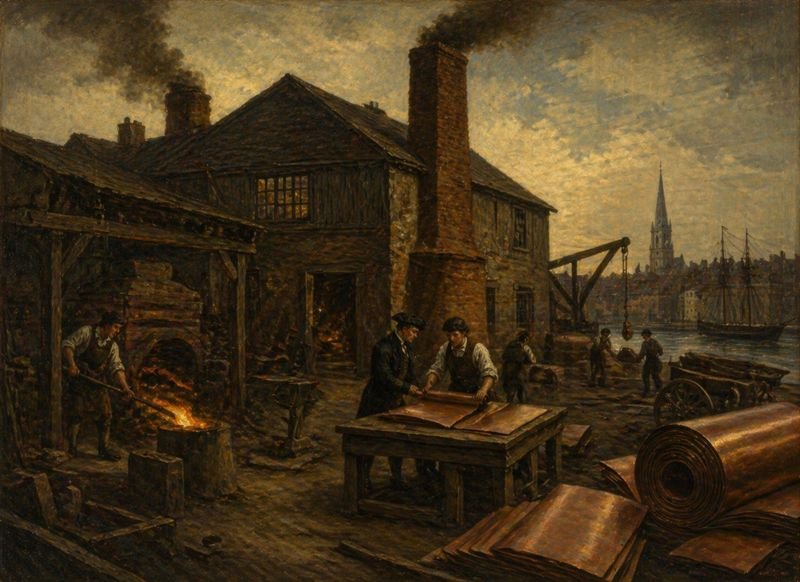
Revere’s experience as a goldsmith also contributed to his later ventures in manufacturing. The skills he developed, understanding materials, managing production, and maintaining quality etc., were transferable to larger-scale enterprises. After the American Revolution, he moved into industries such as copper rolling, where similar principles applied, even if the materials and scale were different.
In a broader sense, Revere’s work as a goldsmith highlights the nature of craftsmanship in colonial America. Artisans were not limited to a single narrow specialty but were expected to master a range of techniques and adapt to the needs of their customers. This versatility was both a practical necessity and a source of professional pride.
Paul Revere’s involvement in goldsmithing was an extension of his training, his skill, and his business sense. It allowed him to broaden his work, serve a wider community, and develop the technical expertise that would support his later achievements. whilst less well known than his silversmithing, it remains an important part of understanding his life as a craftsman and entrepreneur in colonial Boston.