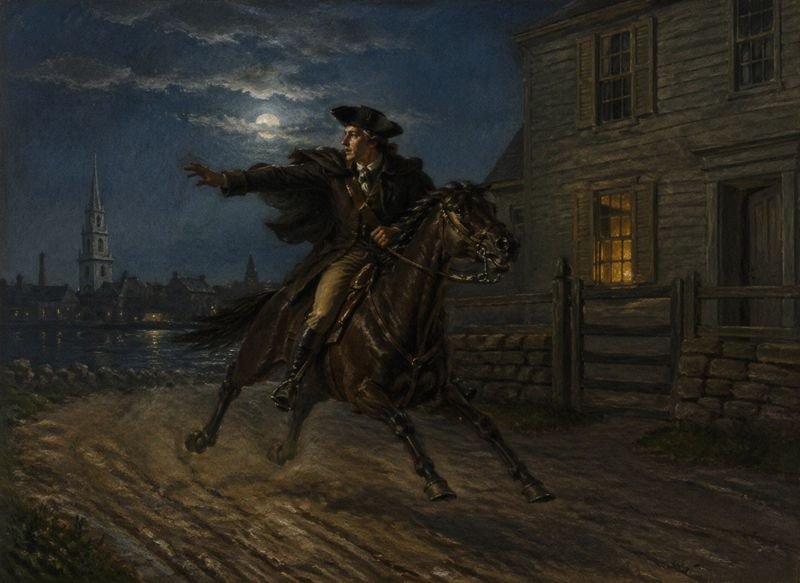
Paul Revere’s involvement in the Penobscot Expedition represents one of the most complicated and controversial episodes of his life during the American Revolutionary War. Unlike his celebrated midnight ride or his work in revolutionary communication networks, this event placed Revere in a formal military role and exposed both the strengths and weaknesses of militia leadership in a difficult campaign.
The Penobscot Expedition took place in the summer of 1779, when Massachusetts Militia/authorities organized a large-scale effort to drive British forces from a newly established stronghold at Penobscot Bay, in what is now Maine. The British had occupied the area and begun constructing a fort, aiming to create a base that could disrupt American shipping and potentially establish a loyalist colony. In response, Massachusetts assembled a combined naval and land force to remove the threat.
Revere served as a lieutenant colonel of artillery in this expedition, responsible for managing and deploying the cannons that would support the assault. His appointment reflected both his prior experience with metalworking and munitions, as well as his standing within the revolutionary community. Artillery was a crucial component of 18th-century warfare, and effective use of cannons could determine the success of an attack on fortified positions.
From the outset, however, the expedition faced serious challenges. Coordination between the naval commander, Commodore Dudley Saltonstall, and the land forces under General Solomon Lovell was poor. Decisions were often delayed, and there was uncertainty about how and when to attack the British fortifications. These leadership issues created confusion and undermined the effectiveness of the operation.
Revere’s role within this context was shaped by these broader problems. As an artillery officer, he was dependent on clear direction from senior commanders in order to position and use his guns effectively. The lack of decisive leadership limited the ability of the artillery to play a meaningful role in the early stages of the confrontation. Whilst there were opportunities to press an advantage, hesitation allowed the British to strengthen their defenses.
The situation worsened when British reinforcements arrived by sea. Faced with a stronger enemy force, the American commanders ordered a retreat. What followed was a chaotic withdrawal, with many ships destroyed or abandoned to prevent capture. The land forces were forced to make a difficult and disorganized retreat through the wilderness, marking the expedition as one of the worst naval defeats in early American history.
In the aftermath, attention quickly turned to assigning blame for the failure. Revere became one of several officers accused of misconduct. Charges against him included disobedience of orders and failure to properly support the artillery operations. Critics argued that he had not acted with sufficient urgency or effectiveness during the conflict.
Revere strongly defended himself against these accusations. He maintained that the problems of the expedition were rooted in poor leadership and lack of coordination at higher levels, rather than in his own actions. He argued that he had carried out his duties as instructed and that the management of the campaign had made success difficult, if not impossible. The controversy led to a court-martial, though it did not take place immediately. Revere spent several years seeking an official inquiry to clear his name. When the court-martial was finally held in 1782, he was acquitted of the charges. The court found that he had not been guilty of the misconduct alleged, restoring his reputation to a significant degree.
The Penobscot Expedition is important in understanding Revere because it shows a different side of his character and career. Unlike his earlier activities, which often involved communication, organization, and craftsmanship, this episode placed him in a structured military environment with defined responsibilities and expectations. It also highlights the challenges faced by the American forces during the Revolutionary War, particularly in coordinating complex operations with limited resources and experience.
This event also reflects the nature of the militia system, where officers were often drawn from civilian life and had varying levels of military training. While Revere brought valuable skills to his role, the overall inexperience of command and planning affected the outcome. The expedition’s failure cannot be attributed to any single individual but rather to a combination of factors, including these issues and external pressures.
In the broader context of Revere’s life, the Penobscot Expedition did not define his legacy, but it did shape his later career. The experience likely reinforced the importance of organization and practical problem-solving, qualities that he applied in his post-war industrial ventures. His ability to recover from the controversy and continue contributing to American society reflects his resilience and determination.
Ultimately, Paul Revere’s involvement in the Penobscot Expedition provides a valuable perspective on the complexities of the Revolutionary War. It shows that even well-known figures experienced setbacks and faced criticism, and it underscores the realities of militia/amateur military campaigns during this period. While not as celebrated as other a spects of his life, this episode remains an important part of his story, illustrating both the challenges of leadership and the process of accountability in the early United State