Paul Revere is often remembered for his work as a silversmith and his role in the American Revolution, but his later career as an industrial entrepreneur, particularly his foundry and copper mill, represents a crucial extension of his skills and a bridge between artisan craftsmanship and early American manufacturing. Whilst his major copper rolling mill was established in Canton, just outside Boston, its roots lay in his earlier workshop practices and in the North End environment where he lived and worked. These ventures were closely connected to his wartime experience, including his involvement in producing materials for the revolutionary cause, though the link to gunpowder manufacture was indirect rather than direct.
Revere’s foundry work began during the American Revolutionary War, when the need for locally produced military equipment became clear. The colonies had struggled with shortages of cannon, ammunition, and other supplies, relying heavily on imports that were often unreliable or unavailable. Drawing on his experience as a craftsman, Revere began casting brass and iron objects, including church bells, cannon, and other metal goods. This transition from small-scale silversmithing to larger-scale metal casting was a significant step, requiring new techniques, equipment, and organizational methods.
The foundry represented a natural progression from his earlier work. As a silversmith and goldsmith, Revere had long experience in melting, alloying, and shaping metals. These skills translated into the demands of casting larger objects, even though the scale and complexity were greater. His familiarity with furnaces, molds, and the behavior of metals under heat gave him a strong foundation for this new phase of his career. In this sense, his artisan background was directly linked to his industrial development.
The copper mill, established in 1801 in Canton, marked an even more ambitious step. It was one of the first copper rolling mills in North America, producing sheets of copper that could be used for a variety of purposes, including ship sheathing, roofing, and industrial applications. This enterprise required not only technical knowledge but also investment, planning, and the ability to manage a workforce. It reflected a shift from individual craftsmanship to organized production, aligning with broader changes in the American economy at the turn of the 19th century.
The connection between these industrial ventures and Revere’s earlier involvement in gunpowder and military supply lies in the broader context of wartime necessity. During the American Revolutionary War, Revere had contributed to efforts to produce gunpowder components and other materials needed for the war effort. whilst he was not directly manufacturing gunpowder in his foundry or copper mill, his work in metal production supported the same goal of reducing dependence on British imports and strengthening local capacity. Cannon, shot, and other metal goods produced in foundries were essential complements to gunpowder, forming part of the overall system of military supply.
His experience during the war likely influenced his decision to expand into larger-scale production. The challenges faced by the colonies, particularly shortages of critical materials, demonstrated the importance of domestic production. Revere’s foundry and copper mill can therefore be seen as part of a broader effort to build a self-sufficient American economy, capable of supporting both civilian and military needs.
At the same time, these ventures remained connected to his earlier work as a silversmith and goldsmith. The skills, reputation, and business relationships he developed in his original trade provided the foundation for his later success. Customers who trusted him with valuable silver and gold were more likely to trust his larger enterprises, and his experience in managing a workshop helped him transition to managing a foundry and mill.
There were also practical links in terms of materials and techniques. Working with precious metals required precision and control, qualities that were equally important in larger-scale production. Whilst the products differed e.g., fine silverware versus industrial copper sheets etc., the underlying principles of craftsmanship remained relevant. Revere’s ability to maintain quality whilst scaling up production was a key factor in his success.
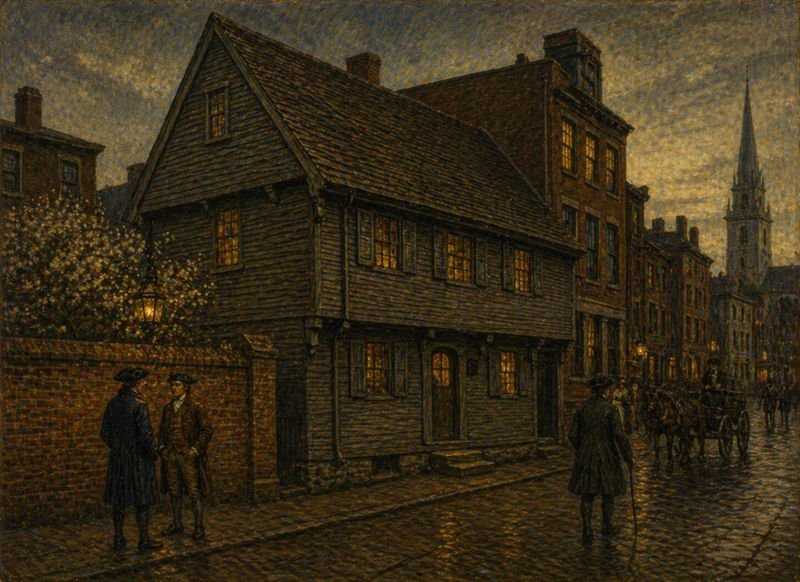
The location of his early work in Boston’s North End also played a role. This district was a center of trade, craftsmanship, and maritime activity, providing access to resources, labor, and markets. Although the copper mill itself was eventually located outside the city, the networks and experience Revere developed in the North End were essential in establishing and sustaining his later enterprises.
In the broader historical context, Revere’s foundry and copper mill represent an important stage in the transition from colonial craftsmanship to early American industry. They illustrate how skills developed in small workshops could be expanded into larger operations, contributing to economic growth and technological development. They also reflect the lasting impact of the Revolutionary War, which highlighted the need for domestic production and encouraged innovation.
Paul Revere’s industrial ventures were not separate from his earlier career but grew out of it. His work as a silversmith and goldsmith provided the technical and social foundation, whilst his wartime experience underscored the importance of self-reliance. Together, these elements shaped his foundry and copper mill, linking craftsmanship, industry, and national development in a way that extended his influence far beyond the events for which he is most widely remembered.