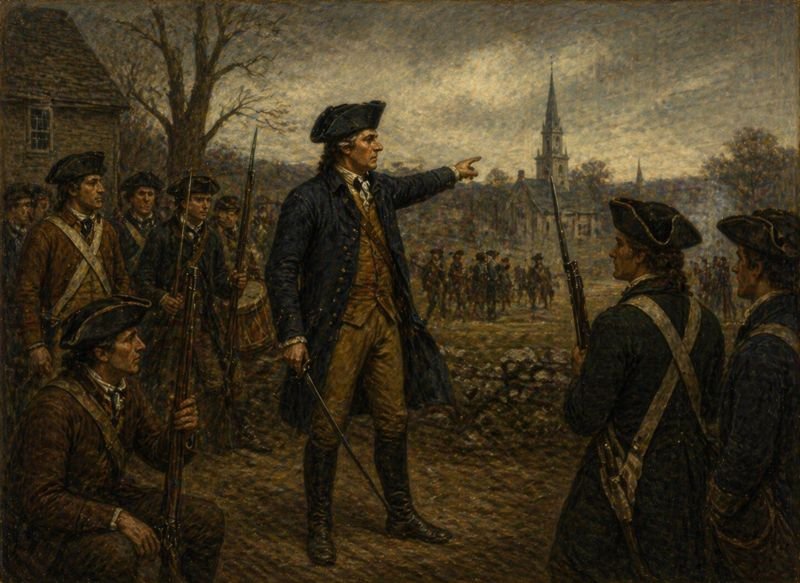
Paul Revere’s “midnight ride” on April 18th/19th, 1775, is one of the most famous episodes in American history, often remembered through a blend of fact, legend, and later storytelling. Whilst the ride was indeed important in the opening moments of the American Revolutionary War, many of the popular images associated with it, particularly those shaped by 19th-century literature, simplify or distort what actually happened. A closer look reveals a more complex, collaborative, and strategically organized event.
The ride took place on the eve of the Battles of Lexington and Concord. British authorities in Boston, under General Thomas Gage, were preparing to send troops to Concord to seize colonial military supplies and potentially arrest patriot leaders such as John Hancock and Samuel Adams. Colonial networks had been monitoring British movements, and when it became clear that troops were about to march, a system of communication was activated.
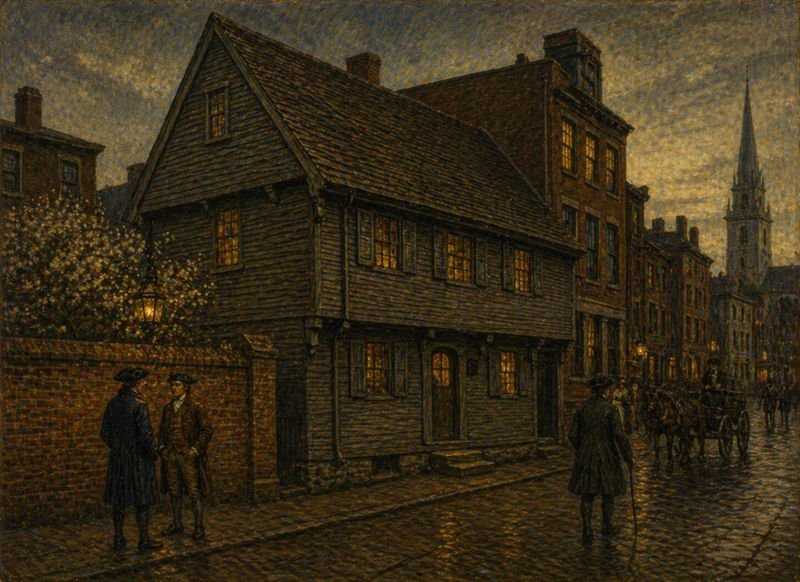
Revere’s role was part of this system and not a spontaneous or solitary act as is often portrayed. He was tasked with riding to Lexington to warn Hancock and Adams, who were staying there, and to help alert the surrounding countryside. Before setting out, he arranged for a signal to be displayed from Boston’s Old North Church; lanterns indicating whether British troops were traveling by land or by sea. This detail is often remembered as “one if by land, two if by sea,” though it was only one element of a broader warning network.
One of the most persistent myths about the midnight ride is that Revere rode alone, shouting “The British are coming!” as he went. In reality, he was not alone. William Dawes set out on a separate route at roughly the same time, and later they were joined by Samuel Prescott. Together, these riders helped spread the alarm across multiple towns. Moreover, Revere would not have used the phrase “the British are coming,” as the colonists themselves still considered themselves British; instead, warnings would have been more specific, referring to “regulars” or troop movements.
Another misconception is that Revere’s ride single-handedly mobilized the colonial militias. In truth/actuality, the warning system was already well established, involving local riders, church bells, signal fires, and word of mouth. Revere’s contribution was important, but it was one part of a coordinated effort that allowed information to spread rapidly across the region. This network ensured that militia units were prepared and able to respond quickly when British troops arrived.
Revere successfully reached Lexington and delivered his message, but his journey did not end there. After meeting with Hancock and Adams, he continued on toward Concord with Dawes and Prescott. Along the way, they encountered a patrol of British soldiers. Revere was captured and detained for a time, whilst Prescott managed to escape and continue on to Concord, where he delivered the warning. This detail is often overlooked in popular accounts, which tend to present the ride as an uninterrupted success. In reality, the mission was partially disrupted, and its success depended on multiple participants.
The mythologizing of Revere’s ride owes much to Henry Wadsworth Longfellow’s 1860 poem “Paul Revere’s Ride.” Written nearly a century after the event, the poem transformed Revere into a lone heroic figure, emphasizing individual action over collective effort. Whilst the poem played an important role in shaping American cultural memory, it also simplified the historical reality, downplaying the contributions of others and the complexity of the communication network.
Despite these myths, the significance of Revere’s ride should not be understated. His actions helped ensure that key leaders were warned and that the alarm system was activated at a critical moment. The rapid spread of information allowed colonial militias to mobilize in time to confront British forces at Lexington and Concord, marking the beginning of armed conflict.
What the more accurate account reveals is that the midnight ride was not a story of solitary heroism, but of organization, preparation, and cooperation. Revere’s role was important because he was a trusted and reliable participant in a larger system. His experience as a courier for revolutionary committees had prepared him for this task, and his familiarity with local routes and communities made him effective in carrying out his mission.
Understanding the midnight ride in this way provides a clearer picture of how the revolutionary movement operated. It was not driven solely by dramatic individual acts, but by networks of communication and collective action. Revere’s ride exemplifies this dynamic, showing how coordination and trust could translate into decisive action at a critical moment.
In the end, Paul Revere’s midnight ride remains a powerful symbol, but its true significance lies in what it reveals about the nature of the American Revolution itself; a movement built on collaboration, communication, and the ability to respond quickly to unfolding events.